




Buy Your First Home
With Confidence
Learn exactly what successful first home buyers do before they purchase. A masterclass guided by decades of Australian mortgage expertise.

Loved by 746+ first-time home buyers
business stats
Proven Expertise You Can Bank On
We combine deep market knowledge with a human touch to ensure your first home journey is smooth and successful.
Grants & Schemes
Every First Home Buyer Grant & Scheme, Explained
There are more pathways into home ownership than most Australians realise. Here’s the full map
From 10k
First Home Owner Grant
A one-off cash grant to help eligible buyers purchase or build a new home.
5% deposit
First Home Guarantee
Buy with a 5% deposit and avoid Lenders Mortgage Insurance (LMI).
2% deposit
Family Home Guarantee
Single parents can buy with just a 2% deposit through a government-backed scheme.
Regional
Regional Guarantee
Regional Australians can buy sooner with a 5% deposit and no LMI.
Shared equity
Help To Buy
Shared-equity scheme – the government co-purchases up to 40% of your home.
Use super
FHSSS (Super Scheme)
Use voluntary super contributions to save your deposit, tax-effectively.
Regional
Regional Guarantee
Regional Australians can buy sooner with a 5% deposit and no LMI.
Not Sure Which Grants Or Schemes Apply To You?
Our eligibility checker helps you quickly discover the support programs and concessions you may qualify for.
Your 7-Step Fast Track
From understanding your borrowing capacity to collecting your keys, we’ve mapped out every critical milestone so you know exactly what comes next.
Financial Health Check
Analyse your savings, debt-to-income ratio, and credit score before talking to any lender.
Borrowing Power
Learn how lenders assess your income and why pre-approval is your strongest advantage.
Grant Navigation
Discover FHOG, stamp duty concessions, and government-backed deposit schemes.
Pre-Approval Strategy
Understand what lenders actually assess and how to maximise your chances of approval.
Auction vs Private Sale
Learn when to bid, negotiate, and protect yourself from costly mistakes.
Conveyancing Essentials
Understand the legal side of buying and avoid expensive contract surprises.
Settlement & Keys
Learn what happens after your offer is accepted through to settlement day.
Your Home Buying Timeline
Follow the complete journey from understanding your finances through to receiving the keys to your new home.
Financial Position
Get a clear picture of income, savings, debts and spending.
Build Deposit
Save, structure and grow your deposit using the right vehicles.
Pre-Approval
Lock in how much a lender will actually let you borrow.
Property Search
Filter by suburb, price, growth potential and lifestyle fit.
Inspections
Know exactly what to look for and what to walk away from.
Make Offer
Negotiate price, conditions and timing with confidence.
Auction
Bid strategically without overpaying on the day.
Contracts & Conveyancing
Understand the legal paperwork before you sign.
Formal Approval
Final lender sign-off on your specific property.
Settlement
Funds exchange and the property becomes legally yours.
Move In
Keys, utilities, insurance and the celebration.
Home Loans In
Plain English
Strip out the jargon and discover the concepts that have the biggest impact on your borrowing power, deposit and long-term wealth.
Borrowing Power
The maximum amount a lender may be willing to lend based on your income, expenses, liabilities and credit profile.
Maximum borrowing power doesn’t necessarily equal comfortable affordability. Always build your budget around lifestyle goals, not the lender’s maximum limit.
SAVING YOUR DEPOSIT
Your probably need less than you think
The 20% rule isn’t a rule. Here’s what each deposit size really unlocks, and how to choose.
Dynamic Deposit Strategy Simulation
Drag to scale target purchase value and dynamically view the deposit requirements
5% Deposit Goal
Acquire with assistance
10% Deposit Goal
Standard with LMI addition
20% Deposit Goal
Bypass insurance outright
STATE GUIDES
First Home Buyer Assistance Changes Depending On Where You Buy
Every state and territory has different grants, stamp duty concessions, guarantees and buyer assistance programs. Select your state below.
New South Wales
- First Home Owner Grant eligibility and application process.
- Stamp duty exemptions, concessions and thresholds.
- NSW-specific shared equity and buyer support programs.
Home Buying Calculators That Give You Real Answers
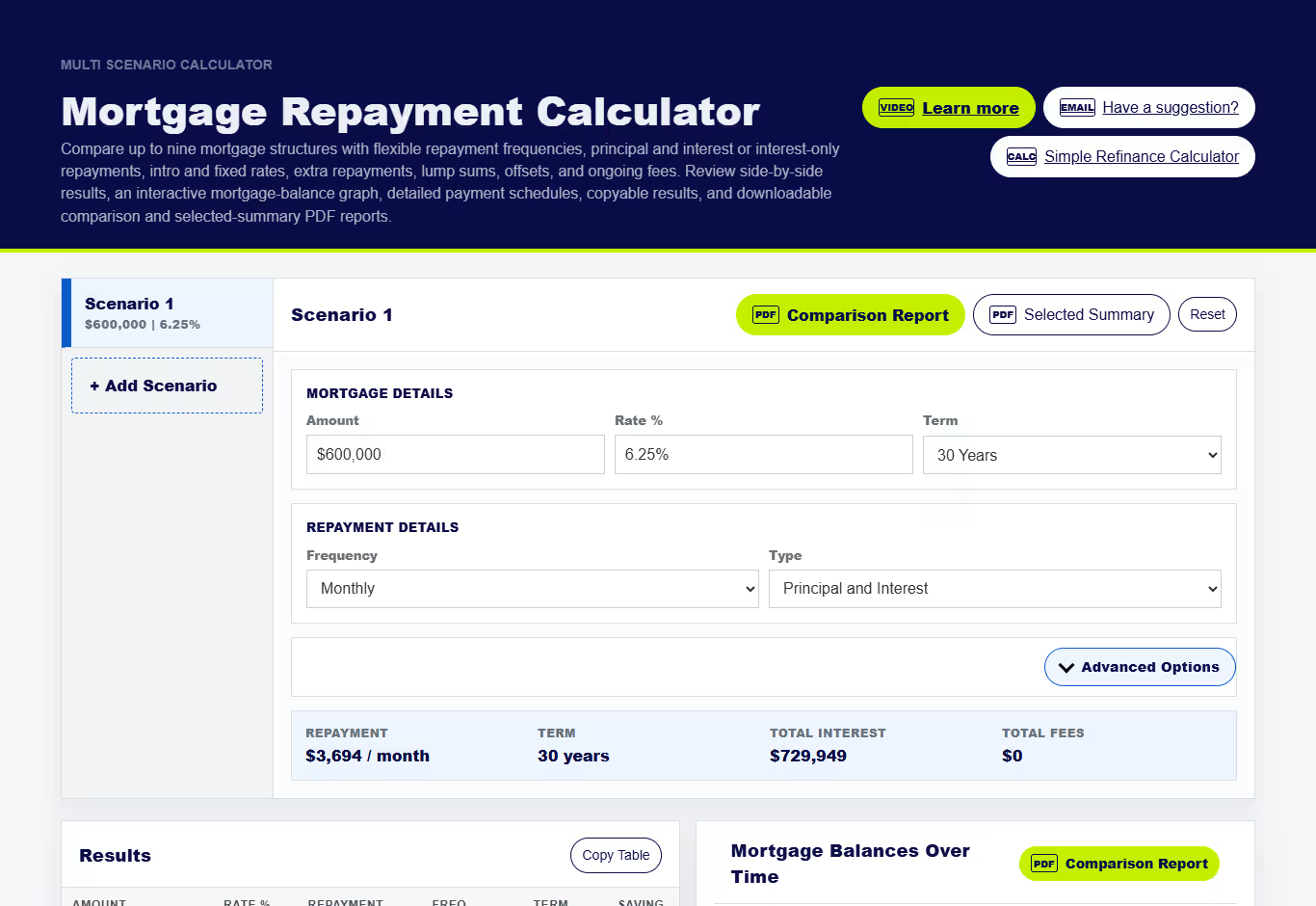
Understand your borrowing power, estimate repayments, calculate your deposit requirements and discover what government assistance may be available before you speak to a lender.
Home Buying Knowledge Base
No. Many Australians purchase property with deposits between 5% and 10%. However, a smaller deposit may require Lenders Mortgage Insurance (LMI) unless you qualify for a government guarantee scheme.
Depending on your state, you may be eligible for the First Home Owner Grant, stamp duty concessions, shared-equity programs and federal guarantee schemes.
Borrowing power depends on your income, living expenses, debts, dependants and credit history. Lenders also assess your ability to manage future interest rate rises by applying a serviceability buffer.
Fixed rates lock your repayments for a set period, offering budget certainty. Variable rates move up or down with market pricing and standard lender configurations, but they usually provide more feature flexibility, like offset accounts.
Yes. Pre-approval provides a realistic budget, strengthens negotiations and prevents wasting time inspecting properties outside your borrowing capacity. Note that pre-approval is not a final guarantee of funding.
Many lenders accept gifted deposits from immediate family members, provided you supply an official gift letter confirming the funds are non-repayable. Some high-LVR loans may still require a portion of "genuine savings" built up over time.
Yes. HECS-HELP repayments reduce your net take-home income once you cross the earning thresholds, which directly lowers your maximum borrowing capacity. The total size of the debt matters less than the monthly repayment impact.
Yes. Lenders assess your credit card's total limit, not the balance you owe[cite: 1]. A $20,000 credit limit with a $0 balance is still treated as a potential $20,000 debt commitment, which can drastically lower your borrowing power[cite: 1]. Reducing or closing unused limits before applying is highly recommended[cite: 1].
LMI protects the lender (not you) if you default on your loan. It typically applies when borrowing more than 80% of the property's value. It can often be avoided through larger deposits or government guarantee schemes.
Both reduce the interest charged on your loan[cite: 1]. However, an offset account is a separate transaction account linked to your mortgage where funds remain fully flexible and accessible[cite: 1]. A redraw facility lets you claw back extra structural payments you've poured directly into the loan itself, subject to the lender's operational rules[cite: 1].
Settlement is when funds are exchanged electronically between legal and financial representatives, ownership titles are formally transferred via state registries, and the property legally becomes yours to collect keys for.
Auctions have no cooling-off periods, and the winning bid is legally binding and unconditional[cite: 1]. This means your finance pre-approval, property inspections, and contract reviews must be fully finalized before auction day[cite: 1].
Most states and territories offer some form of stamp duty concession or exemption for first home buyers, although eligibility rules, income limitations, and property purchase thresholds vary considerably by jurisdiction.
In many cases, yes[cite: 1]. For example, an eligible buyer purchasing a brand new home in Victoria or NSW could potentially stack the First Home Owner Grant (FHOG), a state stamp duty exemption, and a federal Home Guarantee place (allowing a 5% deposit with no LMI) simultaneously[cite: 1].
You must budget for additional upfront expenses paid during the settlement process[cite: 1]. These include conveyancing/solicitor legal fees, building and pest inspections, lender valuation or establishment fees, government transfer registrations, home building insurance, and immediate moving/utility connection costs[cite: 1].
Absolutely[cite: 1]. The traditional cash First Home Owner Grant (FHOG) across most states is strictly limited to new builds, off-the-plan properties, or major structural renovations[cite: 1]. Established properties rarely qualify for cash grants but still frequently unlock stamp duty exemptions or federal deposit guarantee schemes[cite: 1].
For most owner-occupier first home buyers, Principal & Interest (P&I) is the better choice because it builds equity immediately and costs less in total interest over time[cite: 1]. Interest-Only loans offer lower initial repayments, but the loan balance remains completely unchanged, meaning higher long-term costs[cite: 1].
The FHSSS allows you to make voluntary contributions to your superannuation account to save for a home deposit[cite: 1]. Because super is taxed at a lower concessional rate than an ordinary savings account, it lets you grow your deposit faster and more tax-effectively[cite: 1].
Yes, the federal Family Home Guarantee helps eligible single parents or single legal guardians purchase a home with a deposit as low as 2% without paying Lenders Mortgage Insurance (LMI)[cite: 1]. Unlike some other federal programs, this scheme isn't strictly restricted to first-time buyers[cite: 1].
Yes[cite: 1]. Lenders look at income stability rather than employment labels[cite: 1]. Casual employees usually need to demonstrate 6 to 12 months of consistent history with the same employer[cite: 1]. Self-employed borrowers typically need to provide tax returns, financial statements, and business activity statements (BAS) spanning a few years[cite: 1].
A cooling-off period gives a buyer a short legal window to withdraw from a property contract after signing[cite: 1]. However, the rules vary drastically by state, and certain buying methods—such as winning a property at a public auction—typically have no cooling-off options whatsoever[cite: 1].
Ready to stop guessing and start buying?
Join over 5,000 Australians who used the Fast Track method to secure their first home with less stress and better rates.
No credit card required. Instant access to Lesson 1